Royalties for Self-Published Songwriters: How to Get Paid in Canada
Report · Artist Lab Montréal
Royalties for Self-Published Songwriters: How to Get Paid in Canada
Key takeaways
- In Canada, copyright exists once you fix a song by recording it or writing it down. Without a publisher, you are your own publisher.
- Royalties come from several streams: mechanical reproduction, broadcast mechanicals, public performance, neighbouring rights and master royalties for self-released records.
- Eric Cohen of CMRRA said some streaming services can be claimed back to 2004.
- Metadata decides how quickly your money is matched. Register your ISWC and ISRC codes before release.
- Andrea England said splits and demo ownership belong in writing before a song becomes a hit.
Self-published songwriters in Canada can earn royalties from several streams: mechanical reproduction, broadcast mechanicals, public performance, neighbouring rights and master royalties if they release their own recordings. Collective management organizations collect most of these on your behalf and take a commission only on what they collect. Most of the money sits with streaming services and radio stations, so your job is to find it and tie it to your name.
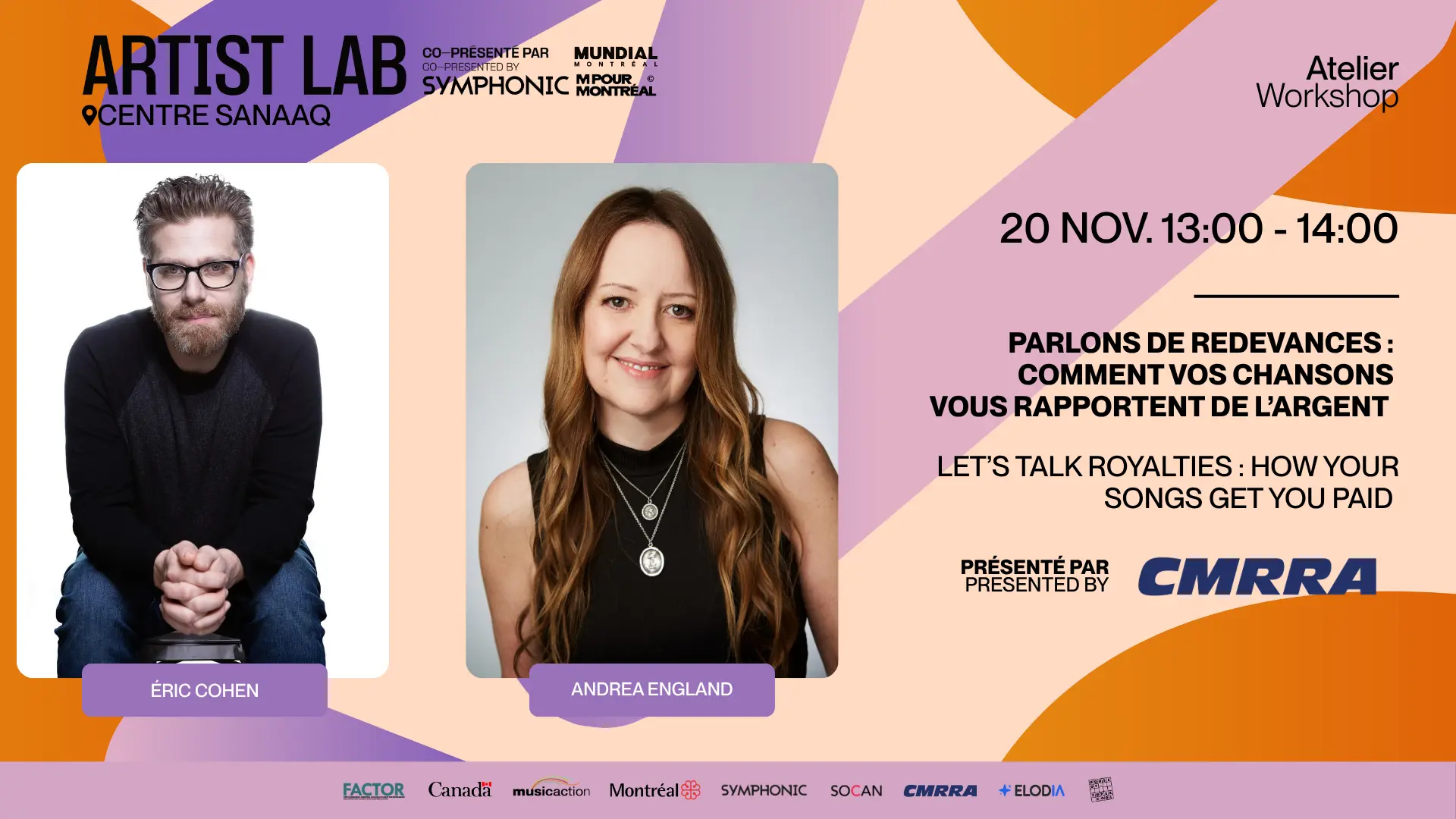
I attended the Artist Lab Montréal panel on royalties for self-published songwriters on November 20. Two representatives of CMRRA, the collective that handles reproduction rights in Canada, ran most of the session. Andrea England, Associate Director of Publisher Engagement and Strategy, walked the room through the royalty slide, metadata, split sheets and the flowchart. Eric Cohen, Industry Relations Consultant for Québec, covered CMRRA’s history, how collection works and what it pays out. A SOCAN representative attended but did not speak during the session.
Table of contents
- What you own when you self-publish
- Which royalty streams you can collect in Canada
- How to get paid without a publisher
- Why metadata decides how fast you get paid
- How to split royalties with co-writers
- What covers, samples and vinyl mean for royalties
- What collecting costs and how long it takes
- Watch: the royalty map
- Frequently asked questions
What you own when you self-publish
Andrea England explained that in Canada you own the copyright as soon as you fix your work, meaning you record it or write it down. That makes you the songwriter and the rights holder from day one. As she put it: “If you don’t have a music publisher, you are your own music publisher.”
“If you don’t have a music publisher, you are your own music publisher.”
Andrea England, CMRRA
A publisher is a contract you choose to sign. Andrea described two kinds of deal. An administrative deal means the publisher submits your claims, collects your money and pays you, typically for 10, 15 or 20 percent. A full deal adds development, co-writing, pitching to artists and, in some cases, travel for writing sessions. Eric Cohen added that a publisher with partners abroad can collect in markets where you have no contacts.
Which royalty streams you can collect in Canada
Andrea laid out five ways to earn in Canada. Four come from your work being copied or performed. The fifth, synchronization for film and TV, is negotiated deal by deal, and she said there are no set rates.
Mechanical reproduction: streams, downloads and vinyl
Each time a song is copied, a mechanical royalty is owed. Eric said streaming and download services operating in Canada send their activity to CMRRA, which matches it to songwriters and publishers. For physical product, he said a song under five minutes pays 8.3 cents per copy pressed, with a little extra for longer songs. At that rate, a million copies of one song would generate about $83,000, and he noted vinyl is having a strong resurgence.
Broadcast mechanicals and public performance
Andrea said a radio play triggers two separate royalties. Before a station airs your song, it copies the file to a server, and that copy creates a broadcast mechanical royalty, which CMRRA collects. The on-air performance creates a public performance royalty, which SOCAN collects. Eric said SOCAN bought CMRRA a couple of months earlier, and that CMRRA still operates as a standalone company.
Neighbouring rights
If you performed on a recording, its public broadcast can pay you neighbouring rights. Andrea said that in Quebec, Artisti and Re:Sound collect these, and that the payments go to the performers on the record: roughly 80 percent to the primary performer and 20 percent split among everyone else.
Master royalties for self-released records
If you record and release your own music, you also own the master recording. Andrea said major labels affiliate with Connect, while small labels and self-releasing artists affiliate with Panorama. That makes you a self-published songwriter and a label at once, with every stream potentially yours.
How to get paid without a publisher
Andrea’s flowchart gives the order of steps. Join SOCAN to register your songs for performance, join CMRRA as a mechanical rights organization if your recordings go on streaming services, and join a neighbouring rights agency if you performed on the recordings. Then keep your data current, because collectives can only pay the names and splits they know about.
Eric described two features that help independent writers. If a co-writer has not registered their share, CMRRA can still pay you for yours once you send in your portion. He also said CMRRA can collect abroad for songwriters without a publisher, through partner organizations in other countries.
“We don’t need 100% in order to pay you.”
Eric Cohen, CMRRA
Eric also pointed to unclaimed money. CMRRA created an Unclaimed Works database at cmrra.ca in 2019. Anyone can search it by songwriter or title, and members can update an entry and file a claim.
Why metadata decides how fast you get paid
Andrea said streaming services report sales as a title and a number. If your song’s number is already in the collective’s system, the match is immediate. If it isn’t, the system falls back on matching by text, which is slower. Titles such as “I Love You” or “Home” match dozens of works, so the numbers do the work.
“It either is 1-2-3-4 or it isn’t.”
Andrea England, CMRRA
She described two identifiers. The ISWC identifies the composition and works like a social insurance number for a song, and you get it when you register the musical work with SOCAN. The ISRC identifies the recording, and your distributor assigns it when you upload. Use the same writer names, splits and codes everywhere you register, and keep them in one spreadsheet.
How to split royalties with co-writers
Andrea’s advice was to set the splits before the song is finished, not after it becomes a hit. She suggested 90/10 when one writer has nearly finished a song and a second adds a small piece, and 50/50 when both writers built it together. She also said to decide who owns the demo, because a producer who paid for the session may claim it later if nobody wrote it down.
“So agree on who owns the song and who owns the demo.”
Andrea England, CMRRA
Andrea described a split sheet, a signed page where each writer records their shares. If you don’t have one, an email confirming the agreed splits and attaching the work tape does the job. She gave an example email in which the writers agree on 50/50 for the song and the demo and attach the work tape.
What covers, samples and vinyl mean for royalties
In the audience questions, Eric explained that if you press your own original songs on vinyl, you need no mechanical licence, because you are not paying yourself royalties. You keep the sale price. If you record covers, you owe 8.3 cents per song per copy sold to the rights holders.
Andrea said a faithful cover in Canada needs no permission from the original writer, as long as you identify the songwriters so they get licensed and paid. Any change to the song requires the original writer’s agreement. A sample is a different case: she said it has two layers, the recording owned by a label and the composition owned by its writers, so you clear both. Eric pointed to the Beastie Boys as the turning point that made sample clearance standard.
What collecting costs and how long it takes
Eric said membership in CMRRA is free. The organization takes a commission only on what it collects: about 10 percent for vinyl, about 6 percent for online and about 5 percent for international. He said that ranges from 5 to 10 percent, and that the organization is not paid until you are.
“We don’t get paid until you get paid.”
Eric Cohen, CMRRA
Eric described a quarterly cycle. Money arrives from services in one quarter, gets invoiced and collected, and is paid out in the next, so he said it takes three to six months to reach you. He also said CMRRA distributed about $3 million to its clients last year.
Watch: the royalty map
The panel’s flowchart asks a series of simple questions: did you write the song, is there a publisher, is there a release, did you perform on the recording, and did you release it yourself. A short walkthrough would turn that chart into a map you can follow at your desk. Suggested title: “The Royalty Map: Which Canadian Organizations to Join for Each Income Stream.”
Video summary: This walkthrough follows one song from first draft to payout. It shows which organization to join at each step, from registering a song with SOCAN to claiming master royalties on a self-released record. It also covers the metadata and split sheet habits that decide how quickly the money arrives.
Frequently asked questions
Do I need a publisher to earn royalties in Canada?
No. Once you fix a song, you own its copyright, and you can register with collectives to collect royalties yourself. A publisher adds pitching, development and sometimes advances, but it is a choice, not a requirement for getting paid.
Do I need a licence to release a song online?
Usually not from CMRRA. Digital services and stores handle licensing for downloads and streams in Canada, so you register with the right collectives and they take care of the rest. Physical releases of songs you didn’t write need a mechanical licence for each copy sold.
How much does CMRRA charge?
Membership is free. CMRRA takes a commission only on the royalties it collects. Eric put the range at 5 to 10 percent, depending on the stream.
Can I claim royalties for songs released years ago?
Often yes. Eric said CMRRA has agreements with major streaming services that allow it to recover activity going back to 2004 for some of them. Search the Unclaimed Works database at cmrra.ca by title or songwriter, and file a claim as a member.
Do I need a split sheet if my co-writer is a friend?
Yes. Friendship doesn’t prevent disputes once a song gets picked up, and collectives pay according to the splits they receive. A split sheet, or an email confirming the shares, gives everyone a record they can rely on later.
Ready to check your royalty setup?
BtheMusic! helps musicians line up their online presence with their release calendar. Book a 15-minute consultation and we will look at your next release together.
Byron Baron
web developer and SEO consultant, BtheMusic! (Montreal)
Byron builds websites and SEO strategies for professional musicians, music schools and creative businesses in Montreal. His background in opera performance shapes how he writes for artists who need a clear story and a plan. He works in English and French.
Rapport · Artist Lab Montréal
Redevances pour auteurs-compositeurs autoédités : comment être payé au Canada
Points clés
- Au Canada, le droit d’auteur existe dès que vous fixez une chanson, en l’enregistrant ou en la consignant par écrit. Sans éditeur, vous êtes votre propre éditeur.
- Les redevances proviennent de plusieurs sources : reproduction mécanique, copies de radiodiffusion, exécution publique, droits voisins et redevances de maître pour les enregistrements autoproduits.
- Eric Cohen, de CMRRA, a indiqué que certains services de diffusion en continu peuvent faire l’objet d’une réclamation jusqu’en 2004.
- Les métadonnées déterminent la rapidité de l’appariement de vos revenus. Inscrivez vos codes ISWC et ISRC avant la sortie.
- Andrea England a affirmé que les parts et la propriété de la maquette doivent être consignées par écrit avant qu’une chanson ne devienne un succès.
Au Canada, les auteurs-compositeurs autoédités peuvent toucher des redevances provenant de plusieurs sources : reproduction mécanique, copies de radiodiffusion, exécution publique, droits voisins et redevances de maître s’ils publient leurs propres enregistrements. Des organismes de gestion collective perçoivent la plupart de ces sommes en votre nom et ne prélèvent une commission que sur ce qu’ils perçoivent. L’argent se trouve surtout chez les services de diffusion et les stations de radio. Votre travail consiste donc à le trouver et à l’associer à votre nom.
J’ai assisté au panel d’Artist Lab Montréal sur les redevances pour auteurs-compositeurs autoédités, le 20 novembre. Deux représentants de CMRRA, l’organisme qui gère les droits de reproduction au Canada, ont mené la majeure partie de la séance. Andrea England, directrice associée, Engagement et stratégie auprès des éditeurs, a présenté la carte des redevances, les métadonnées, les fiches de partage et l’organigramme. Eric Cohen, consultant en relations industrielles pour le Québec, a traité de l’histoire de CMRRA, du fonctionnement de la perception et des montants versés. Un représentant de la SOCAN a assisté à la séance sans prendre la parole.
Table des matières
- Ce que vous possédez lorsque vous vous autoéditez
- Les sources de redevances perceptibles au Canada
- Comment être payé sans éditeur
- Pourquoi les métadonnées déterminent la rapidité de vos paiements
- Comment partager les redevances avec les coauteurs
- Reprises, échantillons et vinyles : ce qu’ils signifient pour les redevances
- Ce que coûte la perception et combien de temps elle prend
- Regardez : la carte des redevances
- Questions fréquentes
Ce que vous possédez lorsque vous vous autoéditez
Andrea England a expliqué qu’au Canada, vous détenez le droit d’auteur dès que vous fixez votre œuvre, c’est-à-dire lorsque vous l’enregistrez ou la consignez par écrit. Vous êtes donc l’auteur-compositeur et le titulaire de droits dès le premier jour. Selon ses mots : « Si vous n’avez pas d’éditeur musical, vous êtes votre propre éditeur musical. »
« Si vous n’avez pas d’éditeur musical, vous êtes votre propre éditeur musical. »
Andrea England, CMRRA
Un éditeur est un contrat que vous choisissez de signer. Andrea a décrit deux types d’ententes. Une entente administrative signifie que l’éditeur soumet vos réclamations, perçoit votre argent et vous paie, généralement moyennant une commission de 10, 15 ou 20 pour cent. Une entente complète ajoute le développement, la coécriture, la promotion auprès des artistes et, dans certains cas, les déplacements pour des séances d’écriture. Eric Cohen a ajouté qu’un éditeur doté de partenaires à l’étranger peut percevoir dans des marchés où vous n’avez pas de contacts.
Les sources de redevances perceptibles au Canada
Andrea a présenté cinq sources de revenus au Canada. Quatre proviennent de la copie ou de l’exécution de votre œuvre. La cinquième, la synchronisation pour le cinéma et la télévision, se négocie contrat par contrat, et elle a précisé qu’il n’existe pas de tarifs fixes.
Reproduction mécanique : diffusion en continu, téléchargements et vinyles
Chaque copie d’une chanson donne droit à une redevance mécanique. Eric a indiqué que les services de diffusion et de téléchargement actifs au Canada transmettent leur activité à CMRRA, qui l’associe aux auteurs et aux éditeurs. Pour le format physique, il a dit qu’une chanson de moins de cinq minutes rapporte 8,3 cents par copie pressée, avec une petite majoration pour les pièces plus longues. À ce taux, un million de copies d’une seule chanson généreraient environ 83 000 $, et il a souligné que le vinyle connaît un fort regain.
Copies de radiodiffusion et exécution publique
Andrea a expliqué qu’une diffusion radio déclenche deux redevances distinctes. Avant que la station diffuse votre chanson, elle en copie le fichier sur un serveur, et cette copie crée une redevance de radiodiffusion mécanique, perçue par CMRRA. La diffusion en ondes crée une redevance d’exécution publique, perçue par SOCAN. Eric a indiqué que SOCAN a acheté CMRRA quelques mois plus tôt, et que CMRRA demeure une entreprise distincte.
Droits voisins
Si vous avez interprété une pièce sur un enregistrement, sa diffusion publique peut vous rapporter des droits voisins. Andrea a indiqué qu’au Québec, Artisti et Re:Sound les perçoivent, et que les paiements vont aux artistes-interprètes de l’enregistrement : environ 80 pour cent à l’interprète principal et 20 pour cent partagés entre les autres.
Redevances de maître pour les enregistrements autoproduits
Si vous enregistrez et publiez votre propre musique, vous détenez aussi le maître. Andrea a indiqué que les grandes maisons de disques sont affiliées à Connect, tandis que les petites étiquettes et les artistes qui s’autoproduisent sont affiliés à Panorama. Vous êtes alors à la fois auteur-compositeur et étiquette, et chaque source peut vous revenir.
Comment être payé sans éditeur
L’organigramme d’Andrea donne l’ordre des étapes. Inscrivez-vous à SOCAN pour l’exécution de vos chansons, joignez CMRRA à titre d’organisme de droits de reproduction mécanique si vos enregistrements se retrouvent sur les services de diffusion en continu, et adhérez à un organisme de droits voisins si vous y avez interprété. Gardez ensuite vos données à jour, car les organismes ne peuvent payer que les noms et les parts qu’ils connaissent.
Eric a décrit deux éléments qui aident les auteurs indépendants. Si un coauteur n’a pas inscrit sa part, CMRRA peut quand même vous payer la vôtre une fois que vous la transmettez. Il a aussi dit que CMRRA peut percevoir à l’étranger pour les auteurs sans éditeur, grâce à des organismes partenaires dans d’autres pays.
« Nous n’avons pas besoin de 100 % pour pouvoir vous payer. »
Eric Cohen, CMRRA
Eric a aussi parlé de l’argent non réclamé. CMRRA a créé en 2019 une base de données des œuvres non réclamées sur cmrra.ca. Tout le monde peut la consulter par auteur ou par titre, et les membres peuvent mettre à jour une fiche et déposer une réclamation.
Pourquoi les métadonnées déterminent la rapidité de vos paiements
Andrea a expliqué que les services de diffusion déclarent leurs ventes sous forme de titre et de numéro. Si le numéro de votre chanson figure déjà dans le système de l’organisme, l’association est immédiate. Sinon, le système se rabat sur un appariement par texte, plus lent. Des titres comme « I Love You » ou « Home » correspondent à des dizaines d’œuvres, alors ce sont les numéros qui font le travail.
« Ça fait 1-2-3-4 ou ça ne le fait pas. »
Andrea England, CMRRA
Elle a décrit deux identifiants. Le code ISWC identifie la composition et fonctionne comme un numéro d’assurance sociale pour une chanson ; vous l’obtenez en inscrivant l’œuvre musicale auprès de SOCAN. Le code ISRC identifie l’enregistrement, et votre distributeur l’attribue au moment du téléversement. Utilisez les mêmes noms d’auteurs, les mêmes parts et les mêmes codes partout, et gardez-les dans un même tableur.
Comment partager les redevances avec les coauteurs
Le conseil d’Andrea : fixez les parts avant que la chanson soit terminée, et non après qu’elle soit devenue un succès. Elle a suggéré une répartition 90/10 lorsqu’un auteur a presque terminé une chanson et qu’un second y ajoute un petit élément, et 50/50 lorsque les deux ont construit la chanson ensemble. Elle a aussi dit de décider qui détient la maquette, car un producteur qui a payé la session pourrait la réclamer plus tard si personne ne l’a consigné.
« Alors entendez-vous sur qui possède la chanson et qui possède la maquette. »
Andrea England, CMRRA
Andrea a décrit la fiche de partage, une page signée où chaque auteur inscrit ses parts. Si vous n’en avez pas, un courriel confirmant les parts convenues et joignant l’enregistrement de travail fait l’affaire. Elle a donné l’exemple d’un courriel où les auteurs conviennent d’une répartition 50/50 pour la chanson et la maquette, et joignent l’enregistrement de travail.
Reprises, échantillons et vinyles : ce qu’ils signifient pour les redevances
Lors des questions de l’auditoire, Eric a expliqué que si vous pressez vos propres chansons originales sur vinyle, aucune licence de reproduction mécanique n’est requise, car vous ne vous payez pas de redevances. Vous conservez le prix de vente. Si vous enregistrez des reprises, vous devez 8,3 cents par chanson et par copie vendue aux titulaires de droits.
Andrea a dit qu’au Canada, une reprise fidèle ne nécessite pas la permission de l’auteur original, à condition d’identifier les auteurs pour qu’ils soient licenciés et payés. Toute modification exige l’accord de l’auteur original. Un échantillon est un cas différent : elle a expliqué qu’il comporte deux couches, l’enregistrement détenu par une étiquette et la composition détenue par ses auteurs, et qu’il faut obtenir les deux autorisations. Eric a cité les Beastie Boys comme le tournant qui a rendu la clairance d’échantillons courante.
Ce que coûte la perception et combien de temps elle prend
Eric a dit que l’adhésion à CMRRA est gratuite. L’organisme prend une commission uniquement sur ce qu’il perçoit : environ 10 pour cent pour le vinyle, environ 6 pour cent pour le numérique en ligne et environ 5 pour cent pour l’international. Il a précisé que cela varie de 5 à 10 pour cent, et que l’organisme n’est payé qu’une fois que vous l’êtes.
« Nous ne sommes pas payés tant que vous ne l’êtes pas. »
Eric Cohen, CMRRA
Eric a décrit un cycle trimestriel. L’argent arrive des services dans un trimestre, est facturé et perçu, puis versé au suivant. Il a dit qu’il faut trois à six mois pour que l’argent vous parvienne. Il a aussi indiqué que CMRRA a distribué environ 3 millions de dollars à ses clients l’an dernier.
Regardez : la carte des redevances
L’organigramme du panel pose une série de questions simples : avez-vous écrit la chanson, y a-t-il un éditeur, y a-t-il une sortie, avez-vous interprété l’enregistrement, et l’avez-vous publié vous-même. Une courte présentation transformerait ce tableau en carte à suivre à votre bureau. Titre suggéré : « La carte des redevances : quels organismes canadiens joindre pour chaque source de revenus ».
Résumé de la vidéo : Cette présentation suit une chanson, de la première ébauche jusqu’au paiement. Elle montre quel organisme joindre à chaque étape, de l’inscription d’une chanson auprès de SOCAN jusqu’à la réclamation de redevances de maître pour un enregistrement autoproduit. Elle aborde aussi les habitudes de métadonnées et de fiches de partage qui accélèrent l’arrivée de l’argent.
Questions fréquentes
Ai-je besoin d’un éditeur pour toucher des redevances au Canada ?
Non. Une fois votre chanson fixée, vous en détenez le droit d’auteur, et vous pouvez vous inscrire auprès des organismes pour percevoir vos redevances vous-même. Un éditeur ajoute la promotion, le développement et parfois des avances, mais c’est un choix, non une condition pour être payé.
Ai-je besoin d’une licence pour diffuser une chanson en ligne ?
En général, non auprès de CMRRA. Au Canada, les services numériques et les boutiques gèrent les licences pour les téléchargements et la diffusion en continu, et vous vous inscrivez auprès des bons organismes. Une sortie physique de chansons que vous n’avez pas écrites exige une licence de reproduction mécanique pour chaque copie vendue.
Combien CMRRA prélève-t-elle ?
L’adhésion est gratuite. CMRRA prend une commission seulement sur les redevances qu’elle perçoit. Eric a situé la fourchette entre 5 et 10 pour cent, selon la source.
Puis-je réclamer des redevances pour des chansons publiées il y a des années ?
Souvent, oui. Eric a dit que CMRRA a conclu des ententes avec de grands services de diffusion en continu qui lui permettent de récupérer une activité remontant à 2004 pour certains d’entre eux. Cherchez votre titre ou votre nom dans la base des œuvres non réclamées sur cmrra.ca, puis déposez une réclamation comme membre.
Ai-je besoin d’une fiche de partage si mon coauteur est un ami ?
Oui. L’amitié n’empêche pas les différends lorsqu’une chanson est reprise, et les organismes paient selon les parts qu’ils reçoivent. Une fiche de partage, ou un courriel confirmant les parts, donne à chacun un document fiable pour plus tard.
Prêt à vérifier votre configuration de redevances ?
BtheMusic! aide les musiciens à aligner leur présence en ligne sur leur calendrier de sorties. Réservez une consultation de 15 minutes et nous examinerons ensemble votre prochaine sortie.
Réserver une consultation de 15 min
Byron Baron
développeur web et consultant SEO, BtheMusic! (Montréal)
Byron conçoit des sites web et des stratégies SEO pour les musiciens professionnels, les écoles de musique et les entreprises créatives à Montréal. Sa formation en interprétation lyrique influence sa façon d’écrire pour les artistes qui ont besoin d’un récit clair et d’un plan. Il travaille en français et en anglais.