How to Get Your Music Licensed for Film and TV
Report · Artist Lab Montréal
How to Get Your Music Licensed for Film and TV
Key takeaways
- A music supervisor finds, fits and clears the songs you hear in film, TV, ads and games. The director, not the supervisor, usually has the final say.
- Nothing gets used until 100% of the master and 100% of the publishing are cleared, so knowing exactly who owns what makes you easy to say yes to.
- Clean metadata wins placements: writer splits, master and publishing owners, real contacts for both sides, and proper registration with your collecting society.
- Send a titled, downloadable WAV. Disco.ac is the standard tool. A streaming link is useless to a supervisor who needs to license fast.
- You don’t need a label. Direct-to-artist deals happen, but you have to be findable, pitch one strong track, and follow up monthly, not weekly.
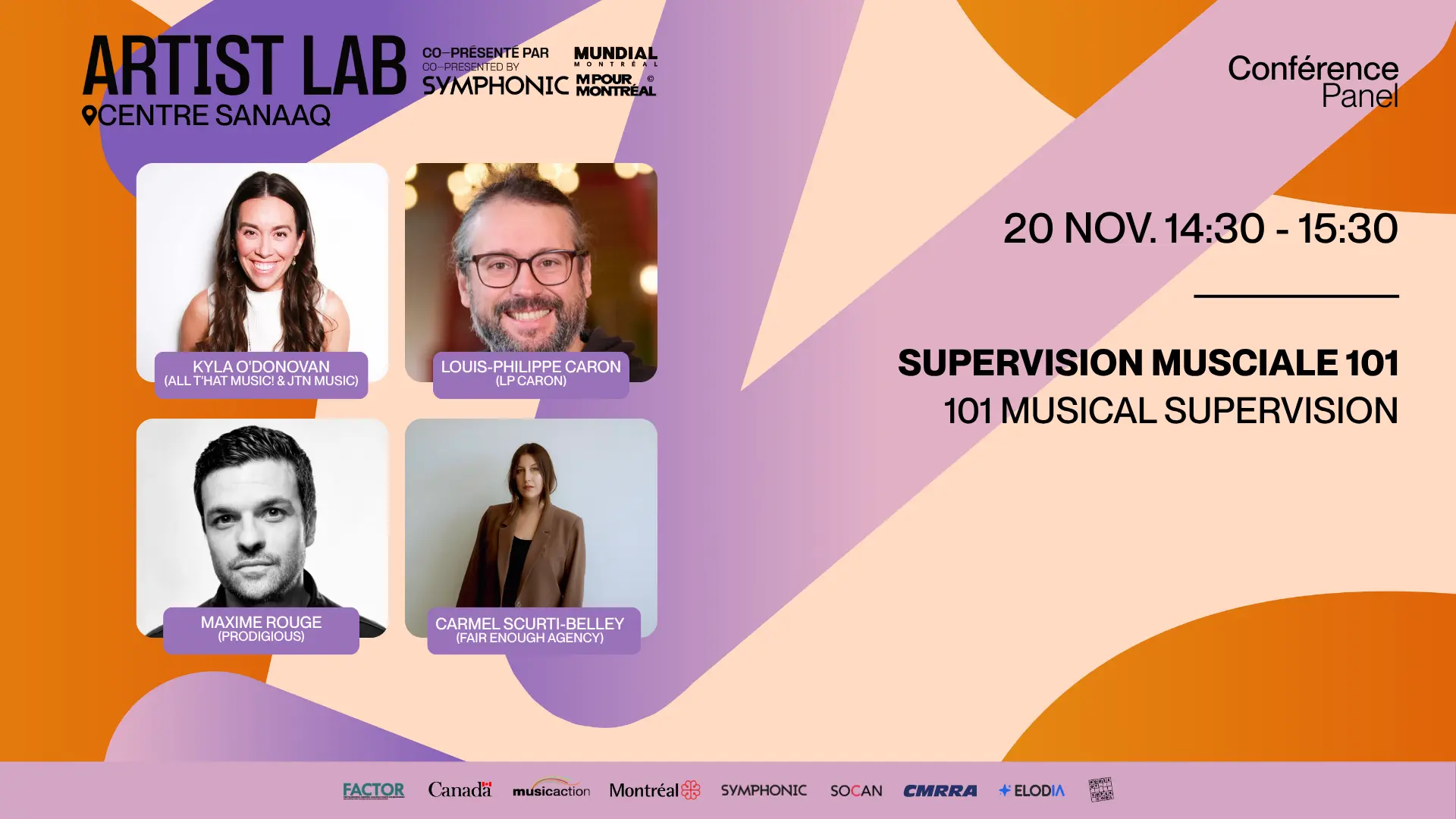
At an independent-artist panel on music supervision in Montreal, three people who place music for a living sat down to explain how sync actually works. I was in the room. Here is what they told it.
Meet the panel
The three supervisors work in three different corners of the business, which is the point: the rules rhyme across film, advertising and games, but the day-to-day does not.
Louis-Philippe Caron spent 15 years in Ubisoft’s music department, on Just Dance, Assassin’s Creed, Far Cry, Watch Dogs and Rocksmith, plus a pile of trailers. Last year he went independent as a music supervisor and rights consultant for video games, working with studios of every size.
Kyla O’Donovan runs her own company, All That Music, in Vancouver, and heads sync for JTN Music, an Emmy-winning editorial house that just opened its first Canadian sync department. She works mostly in independent film, with some TV.
Maxime Rouge has placed music in advertising at Publicis for 12 years, across luxury houses, carmakers and banks. Before that he was a musician for 15 years, and got two of his own band’s tracks synced in the same year.
Sync agent Carmel Scurti-Belley moderated, and threw in an agent’s view where it helped.
What is music supervision?
Music supervision is the work of finding, fitting and clearing music for a screen project, whether that is film, TV, advertising, trailers or games. The supervisor sources songs from labels, publishers, sync agents or artists directly, checks that each one fits the creative, then negotiates the rights and the deal.
Caron put the job plainly: find the right song, make sure it fits the scene, then negotiate with whoever owns the rights to land the right price and a contract that covers what the project needs.
One thing surprises most artists. The supervisor rarely has the final say.
“A lot of artists think we have the final say on what goes into a scene, and we don’t. It’s ultimately the director’s vision.” — Kyla O’Donovan
O’Donovan was blunt about it: sometimes she doesn’t even like the music that ends up in her projects, but she’s hired by production to give them what they want. The day-to-day shifts by sector. In film and TV, her work starts with a spotting session, where the team watches the cut start to stop and decides where licensed music goes. In advertising, Rouge works at high volume and tries to get in at the earliest stage of creation, before choices harden. And across all of it, the creative part is smaller than people imagine. O’Donovan reckons her job is maybe a third to 40% creative; the rest is spreadsheets, contracts and chasing down who owns what, right down to “the 2% publishing that lives in Estonia” that nobody can reach.
Master versus publishing: the two sides you clear
Every song has two sides, and a supervisor has to clear both. The master is the recording. The publishing is the composition, the song itself, owned by the songwriters and composers. To use a track, you need 100% of the master and 100% of the publishing signed off.
Caron used Céline Dion as the example. She doesn’t write her own songs, so the songwriters own the publishing while her label owns the master. Two owners, two clearances. With hip-hop and anything built on samples it multiplies: you clear every writer and publisher in the new song and in each sample underneath it. O’Donovan has sent sync licences to 20 people for a single track.
There are three licences in play: a master licence, a sync licence, and a combined master-sync. When one party controls both sides, that’s a one-stop, the fastest clearance there is. An independent artist who owns both their master and their publishing is a one-stop, and supervisors love that. On Disco you can tag a track as a one-stop, and O’Donovan says those stand out when she’s looking to clear something fast. Flag it when you pitch.
Licence versus buyout
A licence lends your song for a specific use while you keep your rights. A buyout sells them. Some producers will ask you to sell outright; Caron noted that in several European territories, buyouts on licensed tracks are restricted. Understand which one you’re being offered before you sign, and don’t sell your rights because a deal feels urgent.
Exclusive versus non-exclusive representation
Non-exclusive means several partners can pitch your catalog across different territories. Exclusive means one publisher or sync agent represents you, working hard on your behalf in exchange for a cut of your rights. Both are valid. Choose based on how much reach you need and how much you’re willing to give up.
“We want to know all of you”
The panel kept circling back to one idea: the music gets you considered, but the person gets you hired. O’Donovan has placed artists she met at exactly these kinds of events, and she said the relationship often matters as much as the track.
“It’s not always just about the music. It’s about personality and drive. We want to know all of you, as artists.” — Kyla O’Donovan
That cuts against how most artists pitch. A clean track with clean rights gets you in the door. Showing a supervisor who you are, and staying reachable over time, is what keeps you in their head when the right scene lands.
Why clean metadata decides whether you get cleared
If one thing gets you passed over, it’s messy metadata. Supervisors work fast, and a song they can’t quickly clear is a song they skip.
Clean metadata means spelling out who created the song, who owns the master, who owns the publishing, each writer’s split, and a real contact for both sides. Caron’s advice for self-released artists: make all of that clear, and register everything with your collecting society, SOCAN in Canada or SACEM in France, so you can collect backend royalties through the cue sheets filed at the end of a project. Those royalties matter. A modest upfront fee on an indie film can keep paying for years if the film keeps streaming.
Title your files like a professional. “Rough mix 1” tells a supervisor nothing. Mark unreleased tracks, nest instrumental versions under the main track, add stems (the track-by-track files, especially useful in games and interactive music), and attach lyrics. The standard tool is Disco.ac, a cloud platform where a supervisor saves your track straight to their own library with one link. Bridge Audio works too, and O’Donovan was clear that a clean, well-labelled Google Drive folder or zip file is fine. It’s about speed, not the platform.
Two hard rules from the panel. Send a downloadable link, not a Spotify link, because a supervisor can’t save or license a stream. And send WAV files, not only MP3s, because WAV is what music editorial needs once your song is in the edit. Tag your tracks with clear descriptors, too. Supervisors search their own inboxes like a search engine, so the right keywords mean your song resurfaces months later when the right project lands.
How to get your music in front of supervisors
You get in front of supervisors by being findable and by meeting them in person. There’s no single door.
Supervisors discover music through labels, publishers and sync agents first, because those partners pre-vet artists and save them time. They also pull from streaming (O’Donovan’s team doesn’t love Spotify but uses it for the fast, searchable interface), Instagram and TikTok, Bandcamp, college radio and BBC shows. And they show up at business events, game summits like MIGS, film festivals and music conferences, to meet the people who make placement decisions. As O’Donovan put it, leave the room. Introverted artists especially have to treat networking as an investment.
You don’t need a label or publisher to get placed. O’Donovan synced independent Vancouver artist Desiree Dawson’s song “Meet You Like the Light” in her first film, dealing directly with the artist. The upfront fee wasn’t huge, but the film did well and went to Apple, and the backend royalties, in her words, changed Dawson’s life. Caron licensed a then-emerging Montreal band, Half Moon Run, for an Assassin’s Creed trailer back in 2014, a local band on one of Ubisoft’s biggest titles.
To find projects that are hiring, check production databases: Creative BC, Ontario Creates, Quebec’s funding bodies, and IMDb Pro to see who’s working on a given title. Scurti-Belley’s own method as an agent is to track what’s in production and reach out with music that fits. Supervisors circulate briefs through platforms like Mewo. Be careful with brief websites that promise placements or charge for access. The panel warned that many are worthless, and Rouge described someone lifting his briefs and rebranding them as their own. Stay away from anyone selling promises. LinkedIn works as a professional channel, and it has improved a lot; the supervisors use it, even if replies take months.
“Even if it’s very niche, that’s better”
A good pitch is specific. Rouge’s warning was aimed at the producer who says they can make anything.
“We want the specificity of an artist. Even if it’s very niche, it’s better, because we’ll think of you.” — Maxime Rouge
Niche is an advantage, not a liability. It’s the reason a supervisor remembers you when a scene needs exactly that sound. And don’t assume a genre is unsyncable. Caron pointed out that an open-world game can carry seven radio stations across world, rock, punk, reggae and classical, so the medium doesn’t dictate the music; the creative direction does. If you’re unsure whether your music fits sync, the honest answer from the panel was that nobody can predict which project will call for which sound.
So send one track, not ten. Picking your single strongest song for a given supervisor does the filtering for them, and it forces you to know your own catalog. Structure that song to catch an ear fast. Supervisors often listen to the first 45 seconds, so it needs a hook, a build, and a clear beginning, middle and end, not a flat, linear track. Then follow up, but give it room. Reply times are slow because the volume is enormous, and it’s never personal. Rouge’s rule: follow up about once a month, not a week later. And don’t treat another language as a barrier. On a project that calls for it, singing in French, Thai or anything else is an advantage, and O’Donovan pointed to shows like The White Lotus licensing local-language music.
Does AI music threaten sync placements?
Some clients do ask for cheap AI music, but the panel’s supervisors weren’t worried about it replacing real artists, for two reasons.
First, the money and the law favor humans. Rouge explained that AI tools are trained on copyrighted music and the datasets aren’t clean. Newer tools can trace which copyrights a generated track leaned on, which leaves anyone using AI music exposed to claims later. For a brand or a studio, that legal risk isn’t worth a small saving, and clean legal footing is exactly what lets a supervisor defend a placement.
Second, the thing that gets you hired is the thing AI can’t fake: a specific artist with a point of view. As Rouge put it, there are already enough real artists working as fast as AI can generate. Your edge is being unmistakably you.
FAQ
How much do you get paid for a sync placement?
It depends on the project’s budget and how the music is used. Advertising and big brands pay more; independent film budgets are tight. Rouge compared the market to an art market: prices swing with an artist’s profile and the moment. The upfront fee isn’t the whole story, because backend royalties from cue sheets can keep paying long after, especially if the project streams widely.
Is my music even syncable?
Probably, for the right project. The panel’s point was that no supervisor can predict which project will call for which genre, so a style that seems niche can be exactly what a scene needs. Games, for instance, license far more than fast electronic music. Focus on recording and tagging your tracks well rather than second-guessing the genre.
What is a one-stop in music licensing?
A one-stop is a song where a single party controls both the master and the publishing, so a supervisor can clear everything in one conversation. Independent artists who own their recording and their songwriting are one-stops, which makes them faster and easier to license.
What’s the difference between a sync agent and a music supervisor?
A sync agent represents artists and pitches their music to supervisors, in exchange for a cut. A music supervisor works for the production, choosing and clearing the music for a project. An independent artist can work with a sync agent, a publisher, or deal with supervisors directly.
Do I need a publisher or sync agent to get synced?
No. Supervisors place music directly with independent artists all the time. A publisher or sync agent can open doors and handle paperwork, and some specialize in a genre, but plenty of placements happen artist-direct. What matters more is clean rights, clean metadata, and being reachable.
What file format should I send to a music supervisor?
Send a downloadable WAV, not a streaming link and not only an MP3. WAV is what music editorial needs once your track is in the edit. Include instrumental versions and, when asked, stems. Deliver through a tool like Disco.ac or Bridge Audio, or a clean, well-labelled folder.
How often should I follow up after pitching?
About once a month. Supervisors receive an enormous volume of music and reply slowly, so it’s not personal. A follow-up a week later reads as impatient. Leave real space between messages, keep them short, and trust that your email was seen.
Ready to get your music sync-ready?
Most artists lose placements before they ever pitch, not because the music is weak, but because the rights are tangled, the metadata is thin, and nobody can find them. That’s fixable. At BtheMusic! we help independent musicians get the unglamorous parts right: splits documented, master and publishing clear, files titled and delivered the way supervisors actually want them, and a pitch that says what only you do.
Byron Baron, web developer and SEO consultant, BtheMusic! (Montreal)
Byron builds websites and SEO strategies for professional musicians, music schools and creative businesses in Montreal. His background in opera performance shapes how he writes for artists who need a clear story and a plan. He works in English and French.
Reportage · Artist Lab Montréal
Comment faire licencier votre musique pour le cinéma et la télé
À retenir
- Le superviseur musical trouve, ajuste et libère les chansons qu’on entend au cinéma, à la télé, en pub et dans les jeux. C’est le réalisateur, pas le superviseur, qui a le dernier mot.
- Rien ne s’utilise tant que 100 % du master et 100 % de l’édition ne sont pas libérés. Savoir exactement qui détient quoi vous rend facile à dire oui.
- Des métadonnées propres font gagner des placements : parts d’auteurs, détenteurs du master et de l’édition, vrais contacts des deux côtés, et inscription en règle à votre société de gestion.
- Envoyez un WAV titré et téléchargeable. Disco.ac est l’outil standard. Un lien de streaming ne sert à rien à un superviseur qui doit libérer vite.
- Pas besoin d’étiquette. Les ententes directes avec l’artiste existent, mais il faut être trouvable, présenter un seul morceau fort et relancer une fois par mois, pas par semaine.
Lors d’un panel pour artistes indépendants sur la supervision musicale, à Montréal, trois personnes qui placent de la musique pour gagner leur vie ont expliqué comment fonctionne vraiment le sync. J’étais dans la salle. Voici ce qu’elles ont dit.
Le panel
Les trois superviseurs travaillent dans trois coins différents du métier, et c’est tout l’intérêt : les règles se répondent entre le cinéma, la pub et le jeu vidéo, mais le quotidien, lui, change.
Louis-Philippe Caron a passé 15 ans au département musique d’Ubisoft, sur Just Dance, Assassin’s Creed, Far Cry, Watch Dogs et Rocksmith, en plus d’une foule de bandes-annonces. L’an dernier, il est devenu superviseur musical et consultant en droits indépendant pour le jeu vidéo, avec des studios de toutes tailles.
Kyla O’Donovan dirige sa propre société, All That Music, à Vancouver, et pilote le sync pour JTN Music, une maison d’édition primée aux Emmy qui vient d’ouvrir son premier département de sync au Canada. Elle travaille surtout en cinéma indépendant, avec un peu de télé.
Maxime Rouge place de la musique en publicité chez Publicis depuis 12 ans, pour des maisons de luxe, des constructeurs auto et des banques. Avant, il a été musicien pendant 15 ans, et a fait synchroniser deux morceaux de son groupe la même année.
L’agente de sync Carmel Scurti-Belley animait, et glissait un point de vue d’agente quand c’était utile.
Qu’est-ce que la supervision musicale ?
La supervision musicale, c’est le travail qui consiste à trouver, ajuster et libérer la musique d’un projet à l’écran, que ce soit du cinéma, de la télé, de la pub, des bandes-annonces ou des jeux. Le superviseur source les chansons auprès des étiquettes, des éditeurs, des agents de sync ou directement des artistes, vérifie que chacune colle à la création, puis négocie les droits et l’entente.
Caron résume le métier simplement : trouver la bonne chanson, s’assurer qu’elle colle à la scène, puis négocier avec les détenteurs des droits pour obtenir le bon prix et un contrat qui couvre les besoins du projet.
Une chose surprend la plupart des artistes. Le superviseur a rarement le dernier mot.
« Beaucoup d’artistes pensent qu’on a le dernier mot sur ce qui entre dans une scène, et c’est faux. C’est la vision du réalisateur qui tranche. » — Kyla O’Donovan
O’Donovan a été franche : parfois, elle n’aime même pas la musique qui finit dans ses projets, mais la production l’engage pour lui donner ce qu’elle veut. Le quotidien change selon le secteur. En cinéma et en télé, son travail commence par une séance de repérage, où l’équipe regarde le montage du début à la fin et décide où va la musique sous licence. En publicité, Rouge travaille à gros volume et tente d’entrer au stade le plus précoce de la création, avant que les choix se figent. Et dans tout ça, la part créative est plus petite qu’on l’imagine. O’Donovan estime son travail à un tiers ou 40 % de création ; le reste, ce sont des feuilles de calcul, des contrats et la chasse à qui détient quoi, jusqu’aux « 2 % d’édition qui vivent en Estonie » et qu’on n’arrive pas à joindre.
Master contre édition : les deux côtés à libérer
Chaque chanson a deux côtés, et le superviseur doit libérer les deux. Le master, c’est l’enregistrement. L’édition, c’est la composition, la chanson elle-même, détenue par les auteurs-compositeurs. Pour utiliser un morceau, il faut 100 % du master et 100 % de l’édition.
Caron a pris Céline Dion en exemple. Elle n’écrit pas ses chansons : les auteurs détiennent l’édition, tandis que son étiquette détient le master. Deux détenteurs, deux libérations. Avec le hip-hop et tout ce qui repose sur des samples, ça se multiplie : on libère chaque auteur et éditeur de la nouvelle chanson et de chaque sample en dessous. O’Donovan a déjà envoyé des licences de sync à 20 personnes pour un seul morceau.
Il y a trois licences en jeu : une licence de master, une licence de sync, et une licence master-sync combinée. Quand une seule partie contrôle les deux côtés, c’est un one-stop, la libération la plus rapide qui soit. Un artiste indépendant qui détient son master et son édition est un one-stop, et les superviseurs adorent ça. Sur Disco, on peut étiqueter un morceau comme one-stop, et O’Donovan dit que ceux-là ressortent quand elle doit libérer vite. Signalez-le quand vous présentez votre musique.
Licence contre rachat
Une licence prête votre chanson pour un usage précis, et vous gardez vos droits. Un rachat les vend. Certains producteurs demanderont d’acheter tout ; Caron a rappelé que dans plusieurs territoires européens, les rachats sur des morceaux sous licence sont encadrés. Comprenez ce qu’on vous propose avant de signer, et ne vendez pas vos droits parce qu’une entente semble urgente.
Exclusif contre non exclusif
Non exclusif veut dire que plusieurs partenaires peuvent présenter votre catalogue sur différents territoires. Exclusif veut dire qu’un seul éditeur ou agent de sync vous représente, en travaillant fort pour vous en échange d’une part de vos droits. Les deux sont valables. Choisissez selon la portée dont vous avez besoin et ce que vous êtes prêt à céder.
« On veut vous connaître au complet »
Le panel revenait sans cesse à une idée : la musique vous fait considérer, mais c’est la personne qu’on engage. O’Donovan a placé des artistes rencontrés à ce genre d’événements, et selon elle, la relation compte souvent autant que le morceau.
« Ce n’est pas qu’une question de musique. C’est une question de personnalité et d’élan. On veut vous connaître au complet, comme artistes. » — Kyla O’Donovan
Ça va à l’encontre de la façon dont la plupart des artistes se présentent. Un morceau propre, aux droits propres, vous ouvre la porte. Montrer au superviseur qui vous êtes, et rester joignable dans le temps, c’est ce qui vous garde en tête quand la bonne scène arrive.
Pourquoi des métadonnées propres décident de votre libération
S’il y a une chose qui vous fait écarter, ce sont des métadonnées en désordre. Les superviseurs travaillent vite, et une chanson qu’ils ne peuvent pas libérer rapidement, ils la sautent.
Des métadonnées propres, ça veut dire préciser qui a créé la chanson, qui détient le master, qui détient l’édition, la part de chaque auteur, et un vrai contact des deux côtés. Le conseil de Caron pour les artistes autoproduits : rendez tout ça clair, et inscrivez tout à votre société de gestion, la SOCAN au Canada ou la SACEM en France, pour toucher les redevances d’arrière-guichet via les feuilles de minutage déposées à la fin d’un projet. Ces redevances comptent. Un cachet modeste sur un film indépendant peut continuer de payer pendant des années si le film reste en diffusion.
Titrez vos fichiers comme un professionnel. « Rough mix 1 » ne dit rien à un superviseur. Marquez les morceaux inédits, imbriquez les versions instrumentales sous le morceau principal, ajoutez les stems (les fichiers piste par piste, très utiles dans le jeu et la musique interactive), et joignez les paroles. L’outil standard, c’est Disco.ac, une plateforme infonuagique où le superviseur enregistre votre morceau directement dans sa propre bibliothèque avec un seul lien. Bridge Audio fonctionne aussi, et O’Donovan a été claire : un dossier Google Drive propre et bien étiqueté, ou un fichier zip, fait très bien l’affaire. C’est une question de rapidité, pas de plateforme.
Deux règles fermes du panel. Envoyez un lien téléchargeable, pas un lien Spotify, parce qu’un superviseur ne peut ni sauvegarder ni libérer un flux. Et envoyez des fichiers WAV, pas seulement des MP3, parce que le WAV, c’est ce dont le montage musical a besoin une fois votre chanson dans le cut. Étiquetez aussi vos morceaux avec des descripteurs clairs. Les superviseurs fouillent leur boîte de réception comme un moteur de recherche, alors les bons mots-clés font ressortir votre chanson des mois plus tard, quand le bon projet arrive.
Comment mettre votre musique sous les yeux des superviseurs
On se place devant les superviseurs en étant trouvable et en les rencontrant en personne. Il n’y a pas de porte unique.
Les superviseurs découvrent la musique d’abord par les étiquettes, les éditeurs et les agents de sync, parce que ces partenaires présélectionnent les artistes et leur font gagner du temps. Ils puisent aussi dans le streaming (l’équipe d’O’Donovan n’adore pas Spotify mais s’en sert pour son interface rapide et cherchable), Instagram et TikTok, Bandcamp, les radios universitaires et les émissions de la BBC. Et ils se présentent aux événements professionnels, les sommets du jeu comme le MIGS, les festivals de film et les conférences musicales, pour rencontrer ceux qui décident des placements. Comme le dit O’Donovan : sortez de la pièce. Les artistes introvertis, surtout, doivent voir le réseautage comme un investissement.
Pas besoin d’étiquette ni d’éditeur pour être placé. O’Donovan a synchronisé la chanson « Meet You Like the Light » de l’artiste indépendante de Vancouver Desiree Dawson dans son premier film, en traitant directement avec elle. Le cachet n’était pas énorme, mais le film a bien marché et s’est retrouvé sur Apple, et les redevances d’arrière-guichet, selon ses mots, ont changé la vie de Dawson. Caron a licencié un groupe montréalais alors émergent, Half Moon Run, pour une bande-annonce d’Assassin’s Creed en 2014, un groupe local sur l’une des plus grosses marques d’Ubisoft.
Pour trouver les projets qui recrutent, consultez les bases de données de production : Creative BC, Ontario Creates, les organismes de financement du Québec, et IMDb Pro pour voir qui travaille sur un titre donné. La méthode de Scurti-Belley comme agente : suivre ce qui est en production et approcher avec une musique qui colle. Les superviseurs font circuler des briefs sur des plateformes comme Mewo. Méfiez-vous des sites de briefs qui promettent des placements ou facturent l’accès. Le panel a prévenu que beaucoup ne valent rien, et Rouge a raconté que quelqu’un reprenait ses briefs pour les rebaptiser comme les siens. Fuyez ceux qui vendent des promesses. LinkedIn fonctionne comme canal professionnel, et il s’est beaucoup amélioré ; les superviseurs l’utilisent, même si les réponses prennent des mois.
« Même si c’est très niché, c’est mieux »
Une bonne présentation est précise. La mise en garde de Rouge visait le producteur qui dit pouvoir tout faire.
« On veut la spécificité d’un artiste. Même si c’est très niché, c’est mieux, parce qu’on pensera à vous. » — Maxime Rouge
La niche est un avantage, pas un handicap. C’est la raison pour laquelle un superviseur se souvient de vous quand une scène a besoin exactement de ce son. Et ne présumez pas qu’un genre est insynchronisable. Caron a souligné qu’un jeu en monde ouvert peut porter sept stations de radio, du monde au rock, au punk, au reggae et au classique : le médium ne dicte pas la musique, c’est la direction créative qui le fait. Si vous doutez que votre musique convienne au sync, la réponse honnête du panel, c’est que personne ne peut prédire quel projet demandera quel son.
Alors envoyez un seul morceau, pas dix. Choisir votre chanson la plus forte pour un superviseur donné fait le tri à sa place, et ça vous oblige à connaître votre propre catalogue. Structurez ce morceau pour accrocher l’oreille vite. Les superviseurs écoutent souvent les 45 premières secondes, alors il faut une accroche, une montée, et un début, un milieu et une fin clairs, pas un morceau plat et linéaire. Ensuite, relancez, mais laissez de l’espace. Les réponses sont lentes parce que le volume est énorme, et ce n’est jamais personnel. La règle de Rouge : relancez environ une fois par mois, pas une semaine plus tard. Et ne voyez pas une autre langue comme une barrière. Sur un projet qui s’y prête, chanter en français, en thaï ou dans n’importe quelle langue est un avantage, et O’Donovan a cité des séries comme The White Lotus qui licencient de la musique en langue locale.
La musique générée par IA menace-t-elle le sync ?
Certains clients demandent bien de la musique IA bon marché, mais les superviseurs du panel ne craignaient pas qu’elle remplace les vrais artistes, pour deux raisons.
D’abord, l’argent et le droit favorisent les humains. Rouge a expliqué que les outils d’IA sont entraînés sur de la musique sous droits d’auteur, et que les ensembles de données ne sont pas propres. De nouveaux outils peuvent retracer quels droits d’auteur ont nourri un morceau généré, ce qui expose à des réclamations plus tard quiconque utilise de la musique IA. Pour une marque ou un studio, ce risque juridique ne vaut pas la petite économie, et une assise légale propre, c’est justement ce qui permet à un superviseur de défendre un placement.
Ensuite, ce qui vous fait engager, c’est ce que l’IA ne peut pas imiter : un artiste avec un point de vue. Comme le dit Rouge, il y a déjà assez de vrais artistes qui travaillent aussi vite que l’IA peut générer. Votre force, c’est d’être vous, sans confusion possible.
FAQ
Combien paie un placement sync ?
Ça dépend du budget du projet et de l’usage de la musique. La pub et les grandes marques paient plus ; les budgets du cinéma indépendant sont serrés. Rouge comparait le marché à un marché de l’art : les prix varient selon le profil de l’artiste et le moment. Le cachet initial n’est pas toute l’histoire, car les redevances d’arrière-guichet issues des feuilles de minutage peuvent payer longtemps, surtout si le projet est très diffusé.
Ma musique est-elle synchronisable ?
Probablement, pour le bon projet. Le panel insistait : aucun superviseur ne peut prédire quel projet demandera quel genre, donc un style qui paraît niché peut être exactement ce dont une scène a besoin. Le jeu vidéo, par exemple, licencie bien plus que de la musique électronique rapide. Concentrez-vous sur un bon enregistrement et un bon étiquetage plutôt que de douter du genre.
Qu’est-ce qu’un one-stop en licence musicale ?
Un one-stop, c’est une chanson où une seule partie contrôle le master et l’édition, si bien qu’un superviseur libère tout en une seule conversation. Les artistes indépendants qui détiennent leur enregistrement et leur écriture sont des one-stops, ce qui les rend plus rapides et plus faciles à licencier.
Quelle différence entre un agent de sync et un superviseur musical ?
Un agent de sync représente les artistes et présente leur musique aux superviseurs, en échange d’une part. Un superviseur musical travaille pour la production, en choisissant et en libérant la musique d’un projet. Un artiste indépendant peut passer par un agent de sync, un éditeur, ou traiter directement avec les superviseurs.
Ai-je besoin d’un éditeur ou d’un agent de sync pour être synchronisé ?
Non. Les superviseurs placent de la musique directement avec des artistes indépendants tout le temps. Un éditeur ou un agent de sync peut ouvrir des portes et gérer la paperasse, et certains se spécialisent dans un genre, mais beaucoup de placements se font en direct. Ce qui compte plus, ce sont des droits propres, des métadonnées propres, et le fait d’être joignable.
Quel format de fichier envoyer à un superviseur musical ?
Envoyez un WAV téléchargeable, pas un lien de streaming et pas seulement un MP3. Le WAV, c’est ce dont le montage musical a besoin une fois votre morceau dans le cut. Incluez les versions instrumentales et, sur demande, les stems. Livrez via un outil comme Disco.ac ou Bridge Audio, ou un dossier propre et bien étiqueté.
À quelle fréquence relancer après une présentation ?
Environ une fois par mois. Les superviseurs reçoivent un volume énorme de musique et répondent lentement, donc ce n’est pas personnel. Une relance une semaine plus tard paraît impatiente. Laissez de l’espace entre les messages, gardez-les courts, et faites confiance au fait que votre courriel a été vu.
Prêt à rendre votre musique prête pour le sync ?
La plupart des artistes perdent des placements avant même de présenter leur musique, non pas parce que la musique est faible, mais parce que les droits sont emmêlés, les métadonnées sont minces, et personne ne les trouve. Ça se corrige. Chez BtheMusic!, on aide les musiciens indépendants à régler les parties ingrates : parts documentées, master et édition au clair, fichiers titrés et livrés comme les superviseurs les veulent vraiment, et une présentation qui dit ce que vous seul faites.
Byron Baron, développeur web et consultant SEO, BtheMusic! (Montréal)
Byron bâtit des sites web et des stratégies SEO pour les musiciens professionnels, les écoles de musique et les entreprises créatives de Montréal. Son parcours en chant d’opéra façonne sa manière d’écrire pour des artistes qui ont besoin d’un récit clair et d’un plan. Il travaille en anglais et en français.