Music Release Strategy: How to Plan a Release That Gets Heard
Report · Artist Lab Montréal
Music Release Strategy: What Four Industry Pros Told a Room of Musicians
Key takeaways from the panel
- Start your release two to three months out. A release is a plan, not a post.
- Give your distributor five to six weeks with finished audio, artwork and marketing details.
- Pitch playlist curators about three weeks ahead, then send the Spotify link on release day.
- A playlist placement is a bonus, not a verdict. Build visibility first, and it rewards the work.
- Release singles ahead of the album so each one still has a story to pitch.
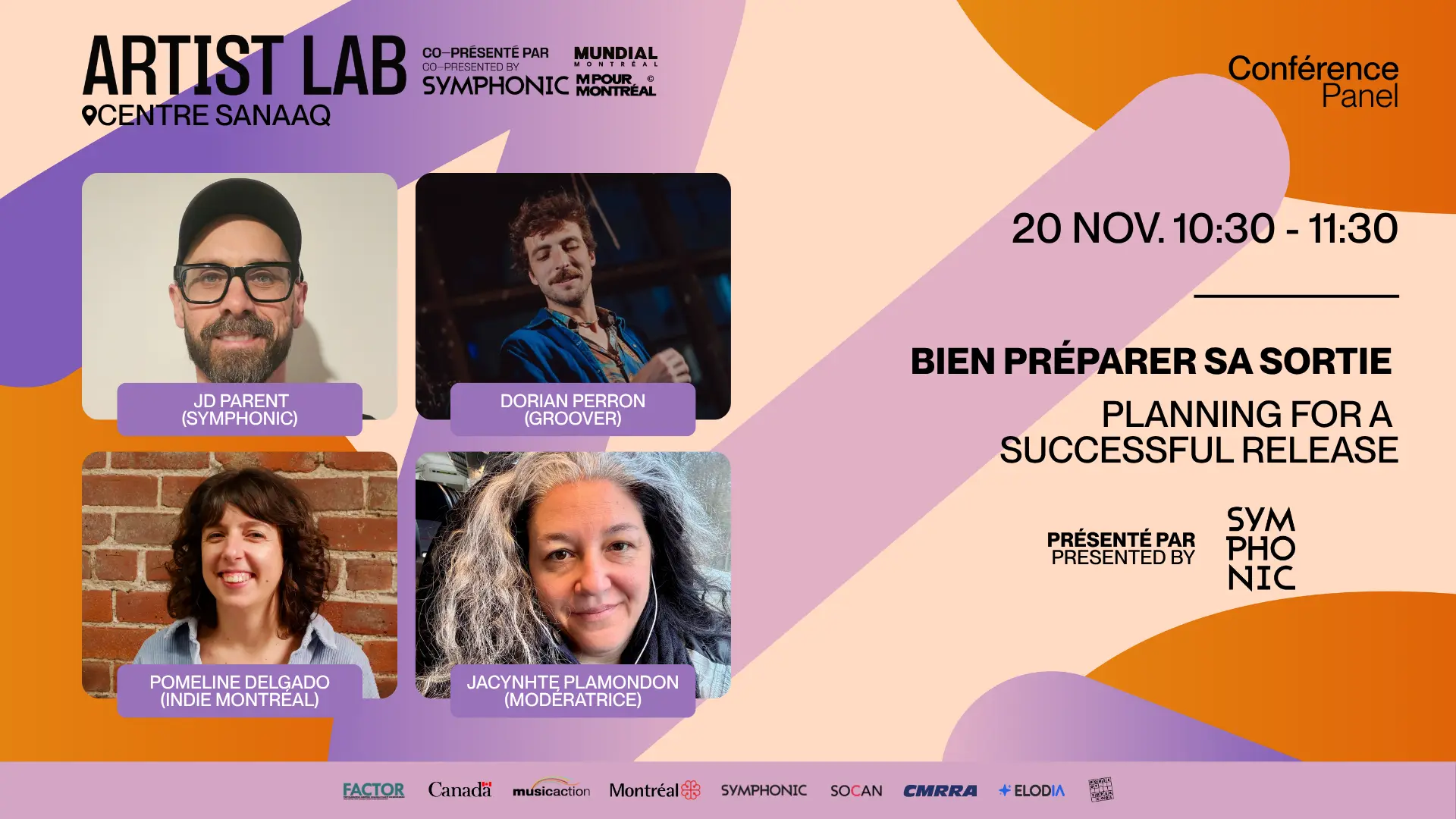
A music release strategy ties your singles, pitches, visuals and promotion to one calendar. The panel’s advice: start two to three months ahead, give your distributor five to six weeks with finished audio and artwork, pitch playlists about three weeks out, and release singles ahead of the album so each one still has a story to tell.
Four people who move music for a living shared one stage at Artist Lab Montréal, and they agreed on the thing most artists get wrong: a release is a plan, not a post. The “Sortir sa musique” panel at Mundial Montréal, on November 20, put a distributor, a playlist-and-media promoter, a publicist and a moderator in front of a room of working musicians. The through-line was time.
On the panel: JD, who handles distribution at Symphonic and spent five years inside Spotify Canada; Dorian, from Groover, who pitches playlist curators, media and DJs; and a publicist, Pomeline, who runs press campaigns and works the line into booking. A moderator kept them moving and recapped each stretch in English. Here is what each of them actually laid out.
Contents
- A release is a strategy, not just marketing
- Give your distributor five to six weeks
- Build a world that makes people press play
- When to send it, and when not to
- “Not the end of the world or the start of a career”
- “It takes ten years to break out overnight”
- Video first, and keep it yours
- How many singles before the album?
- Watch: your six-week release checklist
- Frequently asked questions
A release is a strategy, not just marketing
JD opened on the point he cares about most. Marketing matters, he said, press and radio where a song has commercial legs, but it sits on top of a release calendar rather than in place of one. Streaming platforms want to see thought behind the plan: three singles before an album, or two before an EP, mapped out with your distributor and your team.
Then the small things that get skipped. Update your bio and press photos on Spotify for Artists and Apple Music the moment they change. They are small gestures, he admitted, but they tell the platforms you are putting your best foot forward for your fans.
Give your distributor five to six weeks
The morning of the panel, JD had already pitched the platforms for releases dated three weeks out. That is the pitch window. The delivery itself, he said, Symphonic wants five to six weeks ahead: finished audio, artwork and cover, plus every marketing driver, from press to tour dates to digital campaigns.
It all funnels through their system to him, and he is the one who hands it to the platforms. Miss a piece and your date slips, so treat the package as one deadline, not several.
Build a world that makes people press play
Dorian’s work starts before anyone has heard a note, so he thinks in terms of a visual world: cover art, press photos, social clips, studio footage, even a writing retreat in the Gaspésie woods if that is your story. Prepare it in advance and it can only help the release.
The written side counts too. Keep a long bio and a short one, because independent curators and social teams do not have a journalist’s patience. If your first line lands, it can be enough on its own. Everything, Dorian said, bends toward one question: how fast can the person reading your pitch click play?
When to send it, and when not to
Timing depends on who you are reaching. Magazines, journalists and radio: start several weeks ahead. Groover for independent playlisting: build the campaign early, but send it on release day, when the Spotify link is live and curators can add the track on the spot instead of waiting.
Labels and managers run on a different clock. Do not pitch three days before a single. Send one that is already out, mention the EP or album you are building, and treat it as a first contact. Dorian has watched those cold intros turn into a release a year later with the same partner.
JD: “Not the end of the world or the start of a career”
An artist asked the question that always comes up: what does this cost? JD took the pressure off first. A playlist placement, he said, is neither the end of the world nor the start of a career. It is the cherry on the sundae. Career development is the artist’s job and the team’s, not the platform’s. Support on one song is great; none on the next is not a boycott. Taste plays a part in curation, but the music comes first, the sound of the song. On budget, he was just as plain: there is no magic number, and whatever you spend, show the platforms there is a plan behind it.
“A playlist placement is neither the end of the world nor the start of a career. It should stay the cherry on the sundae.” — JD
Pomeline, the publicist, agreed you can scale to any budget but warned that you need one. Press does not happen on its own, she said; it is work, so it has a cost. She is a fan of soft releases: put more behind the first or second single to introduce the project, then push later tracks through playlists. And she manages expectations hard. A budget buys positioning, not guarantees, and she has had artists whose real press wins came on the second or third campaign. In Quebec, with fewer outlets every year, she tells artists plainly not to run press on every single, but to pick the one with an angle and send another to radio where it has commercial legs.
Dorian: “It takes ten years to break out overnight”
Dorian framed the whole thing as a snowball, a pile of small and often unplanned things. An online radio show with no listeners might still put you in a room with interesting people. “They say it takes ten years to break out overnight,” he said, and the point is not to wait, it is to do a lot and take every opening. Early on, when nobody is offering you anything, say yes. Someone caring about your project is already rare.
“It takes ten years to break out overnight. That does not mean doing nothing while you wait, it means the opposite.” — Dorian
Editorial playlists, he added, reward work you have already done: monthly listeners, an organic presence, small independent playlists, media. Those signals put you on the radar of the people at the platforms. Pomeline made the same case for press, where existing interest only compounds, and it feeds booking too, putting you in front of festival and venue programmers. One habit both pushed: when something happens, say so, because outside validation pulls new listeners in. As the moderator summed it up, there is no minimum or maximum budget; the point is to put it in the right place at the right time.
Video first, and keep it yours
On visuals, JD’s one word was video. Spotify now pairs official clips with a track, live versions cost less and offer another angle, and YouTube’s Shorts recycle straight to Instagram to keep a project’s story moving. Pomeline pushed for a consistent thread across releases, not a concept album, just something that holds attention, and for staying yourself; she pointed to Angine de Poitrine, whose niche branding stays identical through every swing of success.
Dorian’s trick: describe your project in three words that do not overlap, a colour, a sound, a stance, so you can explain it in fifteen seconds and steer your visuals. And on AI, he was blunt: audiences spot a fully generated video and say so in the comments. Start from something real, then use AI for the grunt work, like cutting one YouTube video into ten story clips.
How many singles before the album?
An artist in the room wanted to drop ten tracks over ten months. JD’s answer: plenty of strategies work, so stay flexible. He likes discovering half an album as a fan, and he noted editors sometimes get behind a song you have not released yet, so do not lock yourself in. Dorian would release separately if you are emerging and want each track to have its moment, and warned against dropping everything at once unless you already have the fans.
Pomeline closed it. You cannot work press on an album where every single is already out, she said, it is Christmas with the presents already unwrapped. Leave something to reveal, and leave time between singles, especially early on.
Watch: your six-week release checklist
This section turns the panel’s advice into a checklist you can follow week by week. A short video can walk through the same calendar.
Suggested title: “Your 6-Week Release Checklist: What Distributors and Playlist Curators Need From You”
Frequently asked questions
How long before release should I start planning?
Start two to three months before release day. Lock distributor deadlines at five to six weeks, pitch playlists around three weeks out and send your Spotify link and media pitches on release day. A shorter runway can work for a single you promote through existing contacts, but earlier planning always gives you more options.
Do I need a playlist placement for a successful release?
No. Panelists described playlist support as a bonus, not the measure of a release. Build visibility through your own audience, small playlists and press. Treat editorial support as a reward for work already done, because the fan base you build now makes your next pitch stronger.
How many singles should I release before an album?
For a ten-track album, four or five singles is a common starting point. For a five-track EP, two or three. Leave space between releases, keep some tracks unreleased, and adjust based on which song performs best.
Can I pitch an album after it is already released?
Not the album itself. Once every track is out, there is nothing new to pitch, which is why holding a few songs back keeps a campaign alive. You can still send a released single to a label or manager with a note about your upcoming project. That contact can start a relationship that pays off later.
How much should I spend on a single?
There is no fixed number. Panelists said where you spend matters more than how much. Put more into the first single that introduces the project and less into later releases. Treat the budget as a way to reach new contacts, not a guarantee of placements.
Ready to plan your next release?
BtheMusic! builds release plans around your calendar, your distributor’s deadlines and your visuals. Book a release review and we will map your next three months together.
See how we build a release planBook a release review
Byron Baron, web developer and SEO consultant, BtheMusic! (Montreal)
Byron builds websites and SEO strategies for professional musicians, music schools and creative businesses in Montreal. His background in opera performance shapes how he writes for artists who need a clear story and a plan. He works in English and French.
Reportage · Artist Lab Montréal
Stratégie de sortie musicale : ce que quatre pros de l’industrie ont dit à une salle de musiciens
À retenir du panel
- Commencez votre sortie deux à trois mois à l’avance. Une sortie est un plan, pas une publication.
- Donnez à votre distributeur cinq à six semaines avec l’audio, la pochette et les éléments marketing finalisés.
- Envoyez vos pitchs aux curateurs environ trois semaines à l’avance, puis le lien Spotify le jour de la sortie.
- Un placement en playlist est un bonus, pas un verdict. Bâtissez d’abord votre visibilité, et il récompensera le travail.
- Sortez des singles avant l’album pour que chacun ait encore une histoire à pitcher.
Une stratégie de sortie musicale relie vos singles, vos pitchs, vos visuels et votre promotion à un seul calendrier. Le conseil du panel : commencez deux à trois mois à l’avance, donnez à votre distributeur cinq à six semaines avec l’audio et la pochette finalisés, envoyez vos pitchs de playlists environ trois semaines avant, et sortez des singles avant l’album pour que chacun ait encore une histoire à raconter.
Quatre personnes qui font vivre la musique au quotidien partageaient une même scène à l’Artist Lab Montréal, et elles s’entendaient sur ce que la plupart des artistes ratent : une sortie est un plan, pas une publication. Le panel « Sortir sa musique », au Mundial Montréal, le 20 novembre, réunissait un distributeur, un promoteur playlists-et-médias, une relationniste et une modératrice devant une salle de musiciens en activité. Le fil conducteur, c’était le temps.
Sur le panel : JD, qui s’occupe de distribution chez Symphonic et a passé cinq ans chez Spotify Canada; Dorian, de Groover, qui démarche les curateurs de playlists, les médias et les DJ; et une relationniste, Pomeline, qui mène les campagnes de presse et fait le pont vers le booking. Une modératrice les relançait et résumait chaque segment en anglais. Voici ce que chacun a réellement exposé.
Sommaire
- Une sortie est une stratégie, pas seulement du marketing
- Donnez cinq à six semaines à votre distributeur
- Créer un univers qui donne envie d’appuyer sur play
- Quand l’envoyer, et quand s’abstenir
- « Ni la fin du monde ni le début d’une carrière »
- « Il faut dix ans pour percer du jour au lendemain »
- La vidéo d’abord, et restez vous-même
- Combien de singles avant l’album?
- À regarder : votre liste de contrôle en six semaines
- Questions fréquentes
Une sortie est une stratégie, pas seulement du marketing
JD a ouvert sur le point qui lui tient le plus à cœur. Le marketing compte, a-t-il dit, la presse et la radio quand une chanson a un potentiel commercial, mais il s’ajoute à un calendrier de sortie au lieu de le remplacer. Les plateformes de streaming veulent voir de la réflexion derrière le plan : trois singles avant un album, ou deux avant un EP, planifiés avec votre distributeur et votre équipe.
Puis les petites choses qu’on oublie. Mettez à jour votre biographie et vos photos de presse sur Spotify for Artists et Apple Music dès qu’elles changent. Ce sont de petits gestes, a-t-il reconnu, mais ils montrent aux plateformes que vous mettez votre meilleur pied en avant pour vos fans.
Donnez cinq à six semaines à votre distributeur
Le matin du panel, JD avait déjà pitché les plateformes pour des sorties datées de trois semaines plus tard. C’est la fenêtre de pitch. La livraison elle-même, a-t-il dit, Symphonic la veut cinq à six semaines à l’avance : audio finalisé, artwork et pochette, plus tous les marketing drivers, de la presse aux dates de tournée jusqu’aux campagnes numériques.
Tout passe par leur système jusqu’à lui, et c’est lui qui le transmet aux plateformes. Un élément manquant et votre date recule, alors traitez le paquet comme une seule échéance, pas plusieurs.
Créer un univers qui donne envie d’appuyer sur play
Le travail de Dorian commence avant que personne n’ait entendu une note, alors il pense en termes d’univers visuel : pochette, photos de presse, capsules sociales, images de studio, voire une retraite d’écriture dans les bois de la Gaspésie si c’est votre histoire. Le préparer en amont ne peut qu’aider la sortie.
Le texte compte aussi. Gardez une bio longue et une bio courte, parce que les curateurs indépendants et les équipes des réseaux n’ont pas la patience d’un journaliste. Si votre première phrase fonctionne, elle peut suffire à elle seule. Tout, a dit Dorian, se ramène à une question : à quelle vitesse la personne qui lit votre pitch peut-elle cliquer sur play?
Quand l’envoyer, et quand s’abstenir
Le moment dépend de qui vous visez. Magazines, journalistes et radios : commencez plusieurs semaines à l’avance. Groover pour le playlisting indépendant : préparez la campagne tôt, mais envoyez-la le jour de la sortie, quand le lien Spotify est actif et que les curateurs peuvent ajouter le morceau sur-le-champ, au lieu d’attendre.
Les maisons de disques et les gérants suivent une autre horloge. Ne les contactez pas trois jours avant un single. Envoyez-en un déjà sorti, mentionnez l’EP ou l’album que vous bâtissez, et traitez-le comme une première prise de contact. Dorian a vu ces approches à froid mener à une sortie un an plus tard avec le même partenaire.
JD : « Ni la fin du monde ni le début d’une carrière »
Un artiste a posé la question qui revient toujours : combien ça coûte? JD a d’abord relâché la pression. Un placement en playlist, a-t-il dit, ce n’est ni la fin du monde ni le début d’une carrière. C’est la cerise sur le sundae. Le développement de carrière, c’est le travail de l’artiste et de son équipe, pas de la plateforme. Du soutien sur une chanson, c’est formidable; pas sur la suivante, ce n’est pas un boycott. Les goûts entrent en jeu dans la curation, mais c’est la musique qui prime, le son de la chanson. Sur le budget, il a été tout aussi direct : il n’y a pas de chiffre magique, et quoi que vous dépensiez, montrez aux plateformes qu’il y a un plan derrière.
« Un placement en playlist, ce n’est ni la fin du monde ni le début d’une carrière. Ça doit rester la cerise sur le sundae. » — JD
Pomeline, la relationniste, a convenu qu’on peut s’adapter à tout budget, mais a prévenu qu’il en faut un. La presse ne se fait pas toute seule, a-t-elle dit; c’est du travail, donc un coût. Elle est une adepte des soft releases : mettez-en plus derrière le premier ou le deuxième single pour présenter le projet, puis poussez les suivants par les playlists. Et elle gère fermement les attentes. Un budget achète du positionnement, pas des garanties, et elle a eu des artistes dont les vraies retombées de presse sont venues à la deuxième ou à la troisième campagne. Au Québec, avec de moins en moins de médias chaque année, elle dit franchement aux artistes de ne pas faire de la presse à chaque single, mais de choisir celui qui a un angle et d’en envoyer un autre en radio, là où il a un potentiel commercial.
Dorian : « Il faut dix ans pour percer du jour au lendemain »
Dorian a présenté l’ensemble comme une boule de neige, une accumulation de petites choses souvent non anticipées. Une émission de radio en ligne sans auditeurs peut tout de même vous mettre dans une pièce avec des gens intéressants. « On dit qu’il faut dix ans pour percer du jour au lendemain », a-t-il dit, et l’idée n’est pas d’attendre, c’est d’en faire beaucoup et de saisir chaque occasion. Au début, quand personne ne vous propose rien, dites oui. Que quelqu’un s’intéresse à votre projet, c’est déjà rare.
« Il faut dix ans pour percer du jour au lendemain. Ça ne veut pas dire ne rien faire en attendant, c’est l’inverse. » — Dorian
Les playlists éditoriales, a-t-il ajouté, récompensent un travail déjà fait : auditeurs mensuels, présence organique, petites playlists indépendantes, médias. Ces signaux vous mettent sur le radar des gens chez les plateformes. Pomeline a fait le même raisonnement pour la presse, où l’intérêt existant ne fait que se renforcer, et ça nourrit aussi le booking, en vous plaçant devant les programmateurs de festivals et de salles. Une habitude que tous deux ont défendue : quand il se passe quelque chose, dites-le, parce que la validation extérieure attire de nouveaux auditeurs. Comme l’a résumé la modératrice, il n’y a pas de budget minimum ni maximum; l’important est de le placer au bon endroit au bon moment.
La vidéo d’abord, et restez vous-même
Sur les visuels, le seul mot de JD était vidéo. Spotify jumelle désormais des clips officiels à un morceau, les versions live coûtent moins cher et offrent un autre angle, et les Shorts de YouTube se recyclent directement sur Instagram pour garder vivant le récit d’un projet. Pomeline a plaidé pour un fil constant d’une sortie à l’autre, pas un album concept, juste quelque chose qui retient l’attention, et pour rester soi-même; elle a cité Angine de Poitrine, dont le branding niché reste identique à chaque revers de fortune.
Le truc de Dorian : décrivez votre projet en trois mots qui ne se recoupent pas, une couleur, un son, une posture, pour pouvoir l’expliquer en quinze secondes et orienter vos visuels. Et sur l’IA, il a été direct : le public repère une vidéo entièrement générée et le dit dans les commentaires. Partez de quelque chose de vrai, puis utilisez l’IA pour le travail ingrat, comme découper une vidéo YouTube en dix capsules story.
Combien de singles avant l’album?
Un artiste dans la salle voulait sortir dix morceaux sur dix mois. La réponse de JD : plusieurs stratégies marchent, alors restez flexible. Il aime découvrir la moitié d’un album en tant que fan, et il a noté que les éditeurs se rangent parfois derrière une chanson que vous n’avez pas encore sortie, alors ne vous enfermez pas. Dorian sortirait les morceaux séparément si vous êtes émergent et voulez que chacun ait son moment, et il a déconseillé de tout sortir d’un coup à moins d’avoir déjà les fans.
Pomeline a conclu. On ne peut pas faire de la presse sur un album dont tous les singles sont déjà sortis, a-t-elle dit, c’est Noël avec les cadeaux déjà déballés. Gardez quelque chose à révéler, et laissez du temps entre les singles, surtout au début.
À regarder : votre liste de contrôle en six semaines
Cette section reprend les conseils du panel sous forme de liste à suivre semaine par semaine. Une courte vidéo peut accompagner ce calendrier.
Titre suggéré : « Votre liste de contrôle de sortie en 6 semaines : ce que les distributeurs et les curateurs attendent de vous »
Questions fréquentes
Combien de temps avant la sortie faut-il commencer à planifier?
Commencez deux à trois mois avant le jour de la sortie. Fixez les délais du distributeur à cinq ou six semaines, envoyez les pitchs de playlists environ trois semaines avant, puis le lien Spotify et les pitchs médias le jour J. Un délai plus court peut suffire pour un single promu par vos contacts existants, mais planifier plus tôt vous laisse plus d’options.
Ai-je besoin d’un placement en playlist pour réussir une sortie?
Non. Les panélistes ont décrit le soutien des playlists comme un bonus, pas comme la mesure d’une sortie réussie. Bâtissez votre visibilité avec votre propre public, de petites playlists et la presse. Considérez le soutien éditorial comme une récompense du travail déjà accompli, car la base de fans construite aujourd’hui rendra votre prochain pitch plus solide.
Combien de singles sortir avant un album?
Pour un album de dix chansons, quatre ou cinq singles représentent un point de départ courant. Pour un EP de cinq titres, deux ou trois. Laissez de l’espace entre les sorties, gardez certains morceaux inédits et ajustez selon la chanson qui performe le mieux.
Peut-on pitcher un album déjà sorti?
Pas l’album lui-même. Une fois toutes les pistes publiées, il n’y a plus rien de nouveau à pitcher, d’où l’intérêt de garder quelques chansons en réserve. Vous pouvez tout de même envoyer un single déjà sorti à une maison de disques ou à un gérant, avec une note sur votre projet à venir. Ce contact peut ouvrir une relation qui portera ses fruits plus tard.
Combien dépenser pour un single?
Il n’y a pas de chiffre fixe. Les panélistes l’ont dit : l’endroit où vous dépensez compte plus que le montant. Investissez davantage dans le premier single, qui présente le projet, et moins dans les suivants. Considérez le budget comme un moyen de rejoindre de nouveaux contacts, pas comme une garantie de placements.
Prêt à planifier votre prochaine sortie?
BtheMusic! bâtit des plans de sortie à partir de votre calendrier, des délais de votre distributeur et de vos visuels. Réservez un appel et nous établirons ensemble le plan de vos trois prochains mois.
Voyez comment nous bâtissons un plan de sortieRéserver un appel
Byron Baron, développeur web et consultant SEO, BtheMusic! (Montréal)
Byron conçoit des sites et des stratégies SEO pour des musiciens professionnels, des écoles de musique et des entreprises créatives de Montréal. Sa formation en interprétation d’opéra guide sa façon d’écrire pour des artistes qui ont besoin d’un récit clair et d’un plan. Il travaille en français et en anglais.